Where Does the Electricity We Use in Panama Come From?


Every time we turn on a light, plug in a fan, use the air conditioner, or charge a phone, we rarely think about the journey that electricity took before reaching our home or business.
Energy feels automatic: it’s either there or it isn’t. But behind every switch, there is a complex network of generation, transmission, distribution, and consumption. Understanding it is not just a technical matter; it’s a way to make better decisions about efficiency, savings, and sustainability.
In Panama, electricity does not come from a single source. It comes from a mix.
An Electric Matrix That Changes Every Day
The electric matrix is the combination of sources used to produce a country’s electricity. In Panama, that mix can vary depending on the season, rainfall, demand, fuel prices, plant availability, and the conditions of the electrical system. This means we do not always consume electricity with the same composition. One day may have more hydroelectric participation; another may require more thermal generation; and during certain hours of the day, solar energy may contribute more to the system.
This is an important idea: the electricity we use is not static. It depends on the moment.

Main Sources of Electricity in Panama
1. Hydroelectric Energy
Historically, hydroelectric generation has played a very important role in Panama. It uses the movement of water to produce electricity and can be a significant renewable source within the system. Its great advantage is that it uses a local natural resource. However, it also depends on climatic conditions. When there is less rainfall or lower water availability, its participation decreases and the system must rely more on other sources.
2. Thermal Generation
Thermal generation produces electricity from fuels. Although it is not renewable, it plays an important role in system stability, especially when demand increases or when other sources are not available in sufficient quantity. In simple terms, it works as a backup that helps maintain the electrical supply. The challenge is that it can be associated with higher emissions and variable costs depending on fuel prices.
3. Solar Energy: A Growing Source
Solar energy converts sunlight into electricity through photovoltaic panels. In Panama, solar makes a lot of sense because we have good sun availability throughout most of the year. Its contribution is strongest during daylight hours. This is why solar energy aligns well with homes, businesses, and companies that consume energy during the day—such as offices, workshops, commercial stores, or homes with daytime activity.
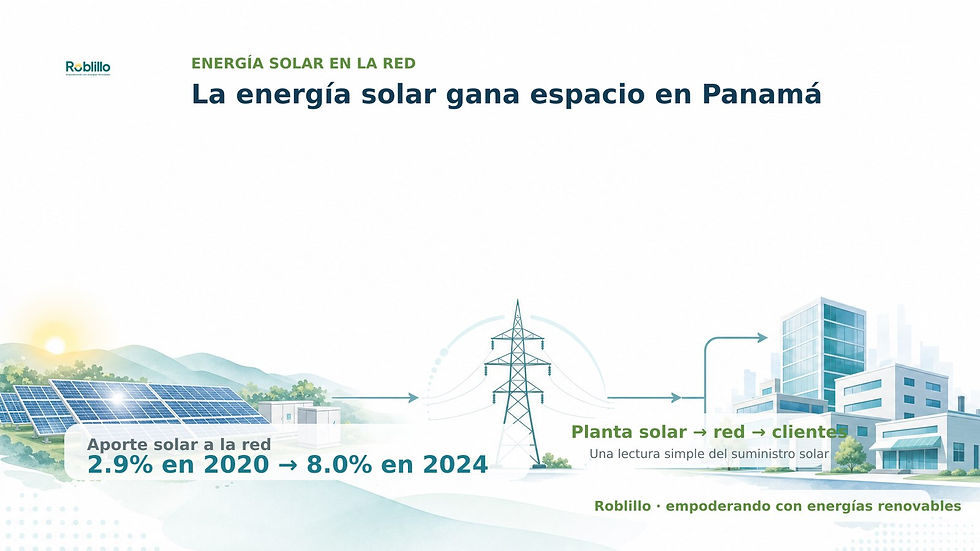
Its growth is already visible in the grid. According to official delivered‑generation data, solar energy went from contributing around 2.9% in 2020 to approximately 8.0% in 2024. By the third quarter of 2025, reported solar contribution reached about 10.3% of delivered generation. This shows that solar energy is no longer a distant technology: every year it plays a larger role in the national electricity supply.
The number of solar projects connected to the system has also grown. The Indicative Generation Plan 2025–2039 shows an existing photovoltaic fleet with more than 700 MW of installed capacity, distributed across multiple solar plants of different sizes. In other words, solar is not only growing as an idea—it is growing as real infrastructure delivering energy to the grid.
This progress opens an important conversation for homes and businesses: if solar is already contributing more and more to the national electrical system, it can also be evaluated as an option close to the point of consumption. That’s where self‑consumption comes in.
Self‑consumption allows a customer to generate part of their own electricity on‑site, usually during daylight hours. It does not automatically replace the grid, but it can reduce the amount of energy taken from it—especially when the system is well designed according to the customer’s real consumption.
4. Wind Energy and Other Renewables
Wind energy uses the wind to generate electricity. Its contribution depends on the resource conditions in each area and moment. Together with solar and hydroelectric energy, it forms part of the group of renewable sources that help diversify the electric matrix.
Diversification is important because it reduces dependence on a single source and makes the system more resilient.
Why Does This Matter to a Home or Business?
Knowing where electricity comes from helps us see consumption differently. It’s not just about paying a bill every month. It’s about understanding that every device turned on, every hour of use, and every efficiency decision has an impact.
For a home, this may mean reviewing habits: air‑conditioning use, lighting, old appliances, or phantom loads. For a business, it may mean analyzing operating hours, main electrical loads, and opportunities to reduce unnecessary demand.
And How Does This Connect to Solar Energy?
Solar energy should not be seen as an isolated solution. It is part of a broader conversation about how we produce, use, and manage electricity. When a home or business installs a solar system, it begins to generate part of its own energy during the day. This can reduce the amount of electricity needed from the grid—especially if the system is well designed according to real consumption.
Conclusion
The electricity we use in Panama comes from a mix of sources: water, fuels, sun, wind, and other contributions from the electrical system. That mix changes with the weather, demand, and daily operation of the country. This is why energy education is the first step. When we understand where electricity comes from and how we use it, we can make better decisions: consume more efficiently, evaluate renewable solutions with criteria, and plan energy investments with greater clarity.


Comments