Green Loans and Solar Self-Consumption: An Option Worth Knowing

When you evaluate whether installing solar energy is the right decision, one of the most important questions that comes up is: How much does a solar panel system cost? It’s a legitimate and central question in the decision-making process, but this blog aims to show that—before answering it—it’s worth considering an option that helps you better understand that cost and its real impact.

In Panama, more and more people are hearing about solar self-consumption, photovoltaic systems, and green loans. The interest is understandable: many families and businesses want to reduce their dependence on electricity bills, use cleaner energy, and make more efficient decisions. But as with any major investment, being well informed is the first step.
1. Solar energy doesn’t always require paying everything upfront
One reason some people postpone a solar decision is thinking they must pay for the entire system in cash. In some cases, that may be an option—but it’s not the only conversation available.
Green loans have begun to emerge as a financial alternative aimed at projects with positive environmental impact, including the purchase and installation of photovoltaic solar systems. In simple terms, these are financing options designed to support more sustainable decisions, such as incorporating solar energy into a home or business.
This doesn’t mean a green loan is automatically convenient for everyone. Nor does it mean that the decision to install solar panels should be made just because financing exists. Rather, it means there is an option worth knowing as part of a broader evaluation.
2. What is a green loan?
A green loan is a financial product designed to generate an environmental benefit or improve resource efficiency. In the case of solar self-consumption, it can help finance the purchase and installation of solar panels and their main components.
The core idea is simple: if a person or business wants to move toward a cleaner energy solution, financing can make it easier to evaluate the project without relying solely on a full upfront payment.
But there’s an important point: the loan must be accompanied by a technical evaluation. Financing a poorly sized, poorly located, or unsuitable system for the customer’s consumption pattern can turn into a bad decision.
3. Why does this option attract interest from households and businesses?
For a household, the interest often relates to gaining more clarity about monthly electricity expenses and evaluating whether solar energy can help optimize consumption in the medium term.
For a business, the topic can be even more strategic. Energy is part of operational costs, and a well‑analyzed solar decision can provide efficiency, better planning, and a more sustainable narrative for clients, partners, and employees.
In both cases, the appeal is not simply “having panels.” It lies in understanding whether the proposed system matches real consumption, whether the roof or available space is adequate, whether the installation meets technical criteria, and whether the economic model makes sense.
4. The decision is not only financial
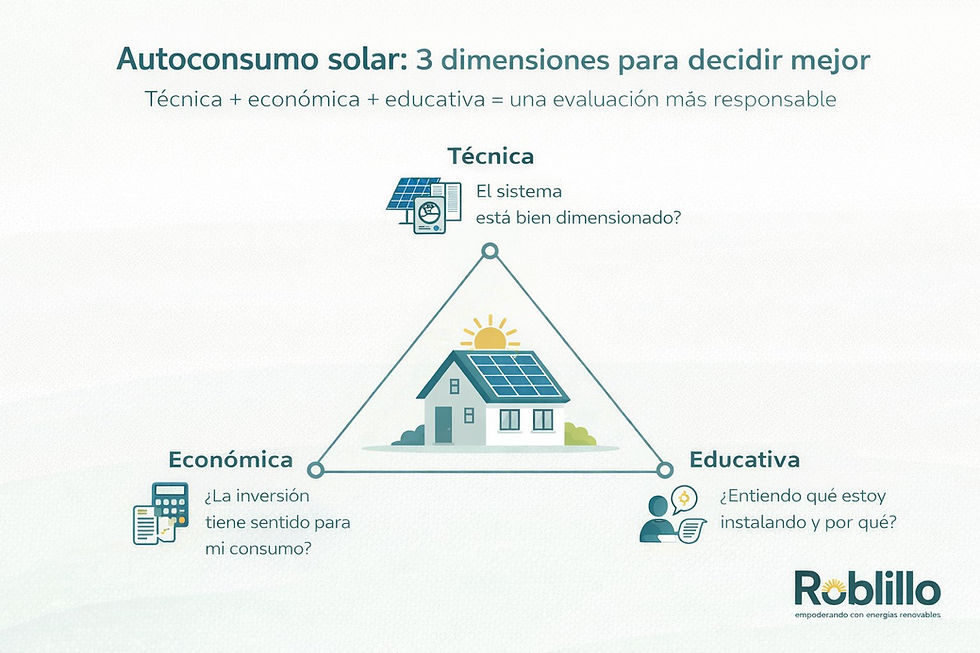
Solar self-consumption combines three dimensions: technical, economic, and educational.
The technical dimension determines whether the system can operate correctly.
The economic dimension helps analyze investment, return, estimated savings, and payment structure.
The educational dimension allows the customer to understand what they are buying, what they can expect, and what they should not assume.
This last dimension is key. A solar system is not just a set of panels on a roof. It includes components such as inverters, mounting structures, electrical protections, metering, monitoring, and, in some cases, batteries. Each element serves a different function. Understanding these differences helps people make better decisions and avoid common misunderstandings.
5. Conclusion
Green loans should not be seen as an invitation to take on debt quickly. They should be seen as a sign that the market is opening more pathways for households and businesses to consider sustainable solutions.
For El Roblillo, the first step is not selling an installation. It is accompanying an informed decision: reviewing consumption, explaining options, clarifying technical questions, and helping each person understand whether solar self-consumption makes sense for their case.
The question is not only: Can I finance solar panels? The more complete question is: Is my home or business ready to evaluate a well‑designed solar solution?
If you want to start that conversation, schedule a consultation with El Roblillo, and let’s review together what information you need before making a decision.


Comments